

Partner Page
HourProof for Cost Seg Firms
Show how better rental activity logs can support conversations around tax strategy, documentation discipline, and year-round client readiness.
Visit page
HourProof helps real estate investors log Short-Term Rental (STR) and Long-Term Rental (LTR) activities, track progress toward IRS material participation thresholds, and maintain contemporaneous records with evidence — so you can deduct rental losses against active income.
HourProof is for informational and record-keeping purposes only and does not constitute tax, legal, or financial advice. Consult your CPA or tax professional for actual tax savings and IRS compliance.


Now on iOS, Android & Web — sign in to get started with Google, Apple, or email.
Purpose-built for real estate investors who need to meet IRS material participation requirements for Short-Term Rental (STR) and Long-Term Rental (LTR) properties.
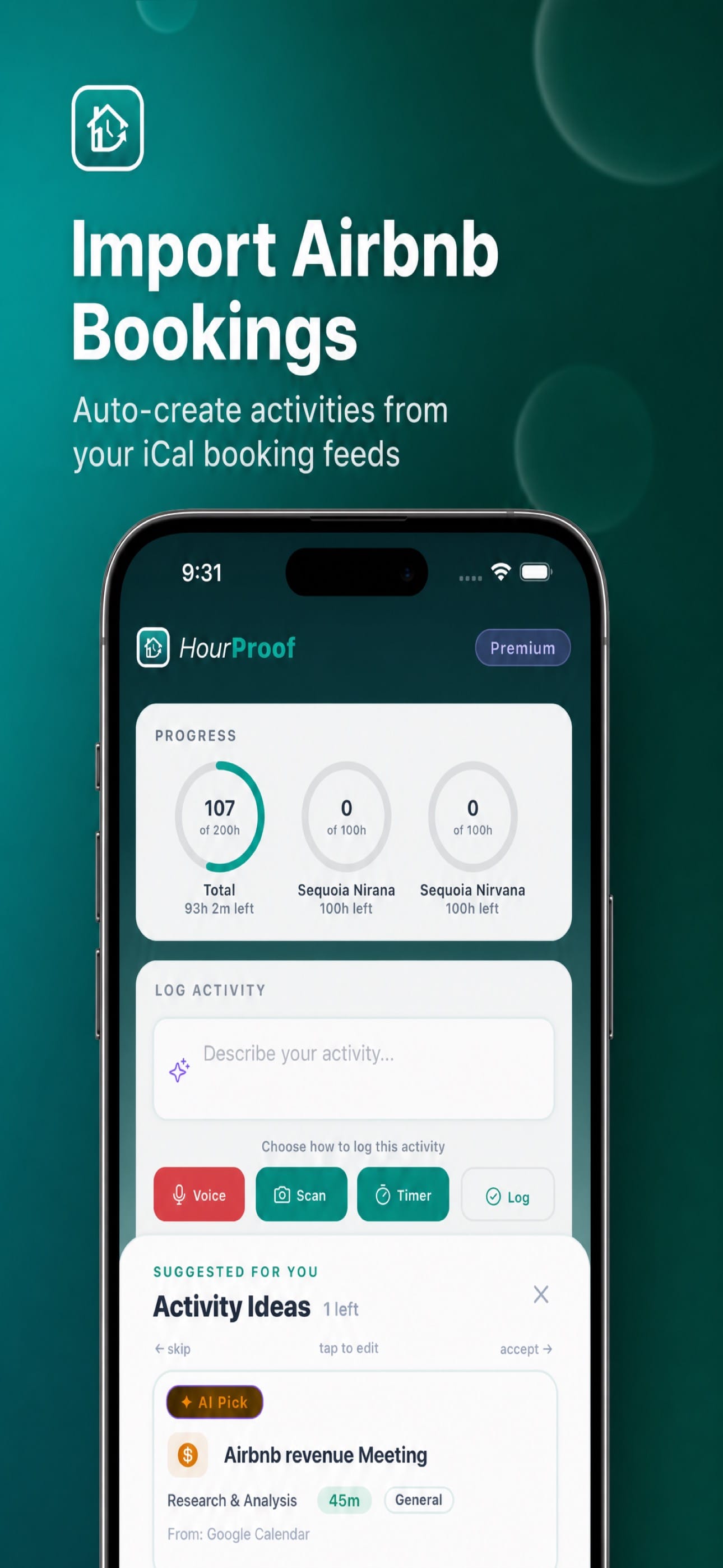
Start a timer when you begin working on a property. Activities are logged with precise duration automatically.
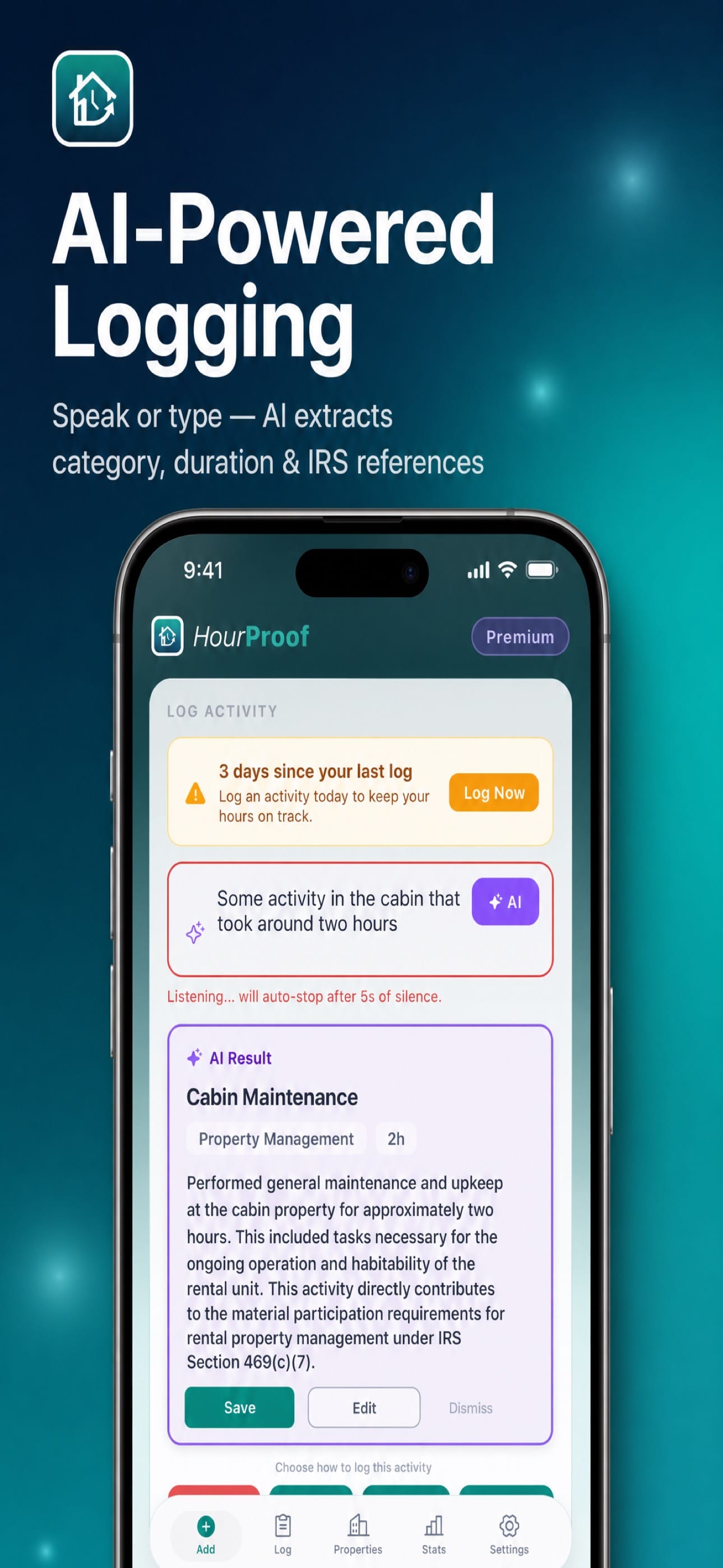
Describe your activity in plain English and let AI extract the category, duration, and property details for you.
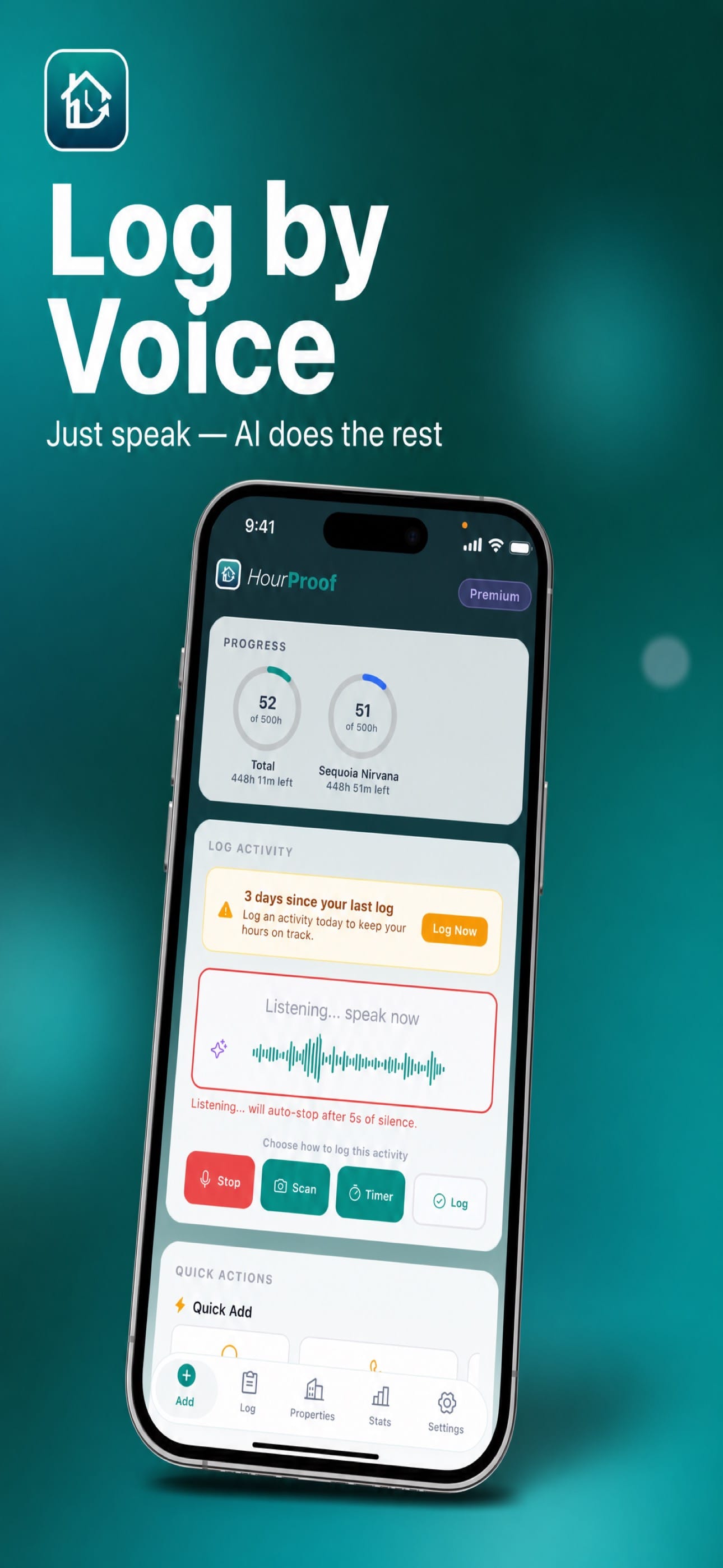
Speak your activities hands-free. Voice recognition converts speech to structured activity logs instantly.
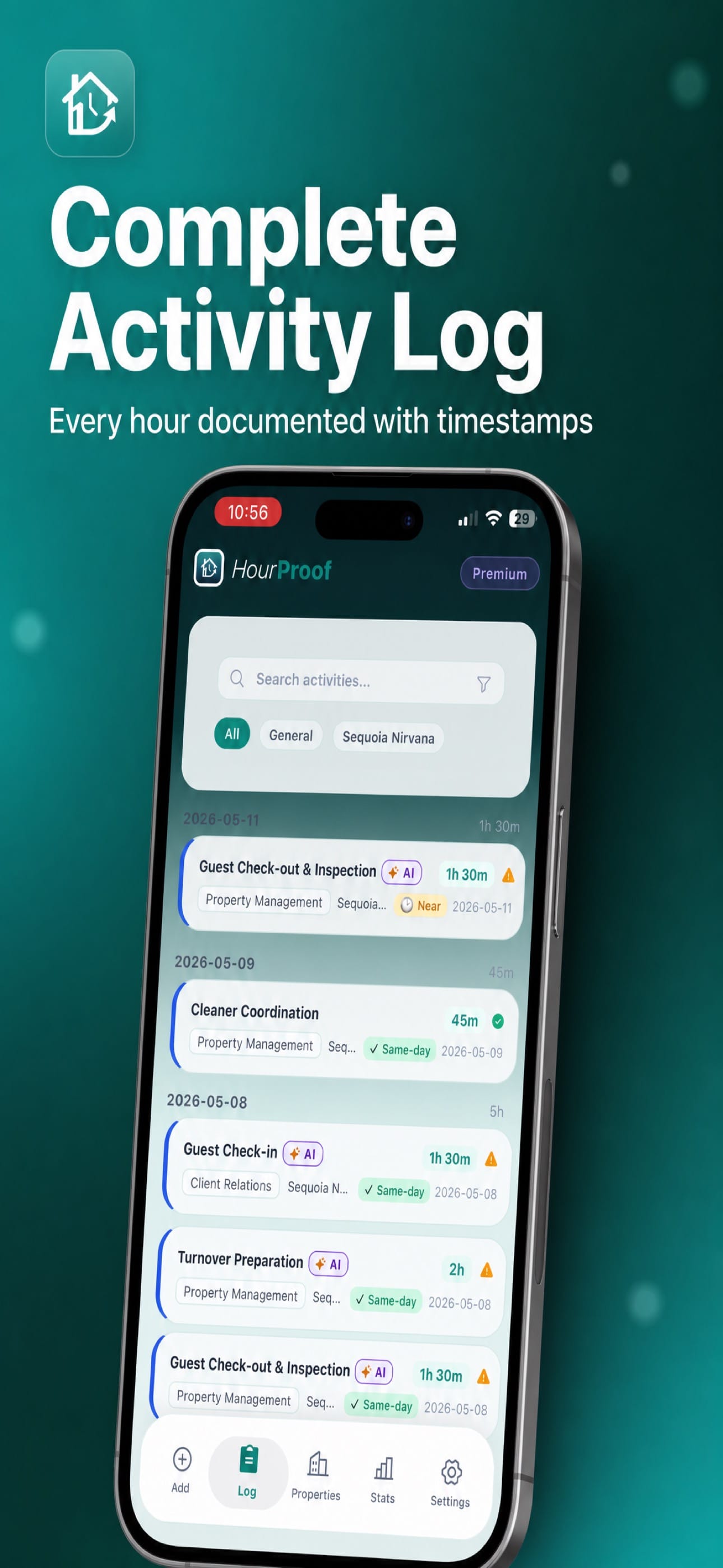
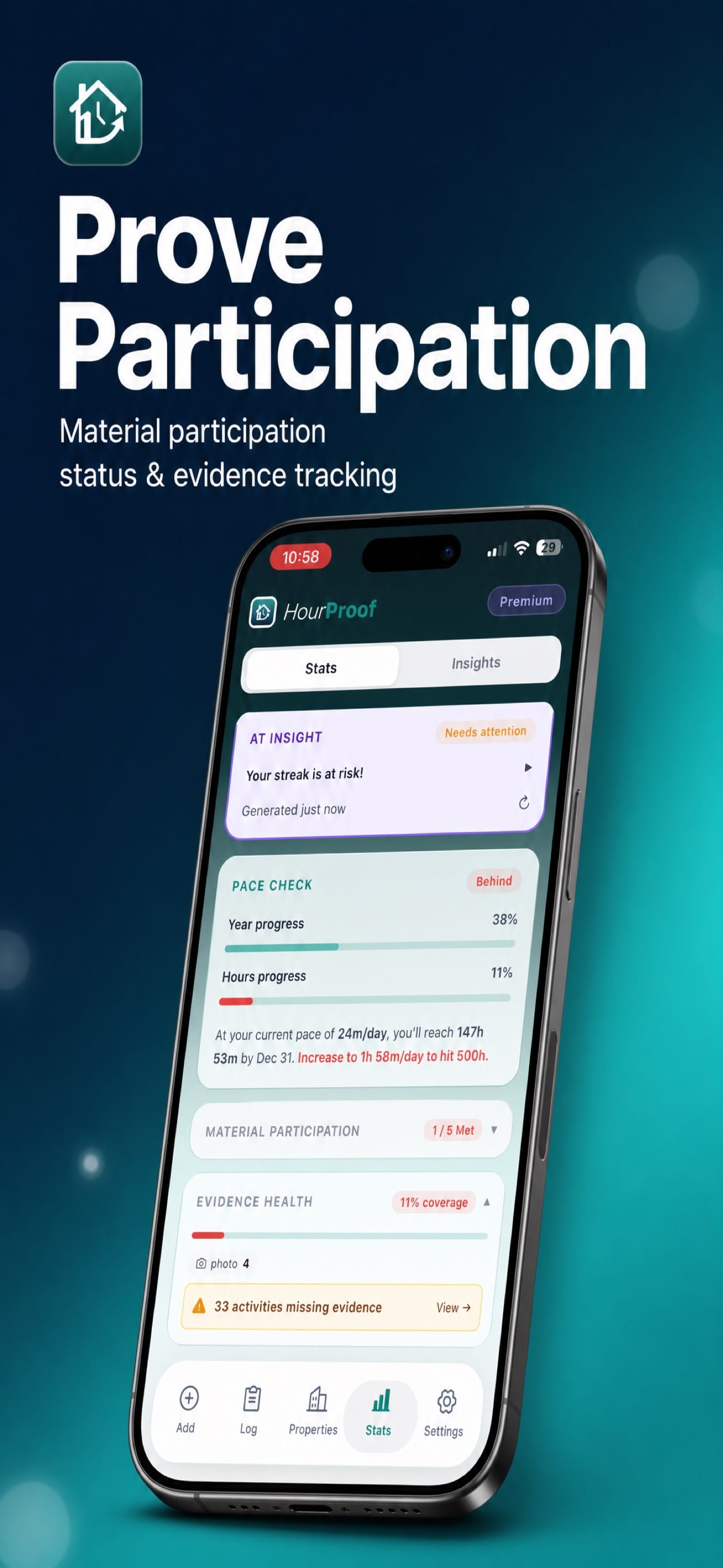
Attach photos, receipts, documents, and emails as evidence to any activity for IRS-ready contemporaneous records.
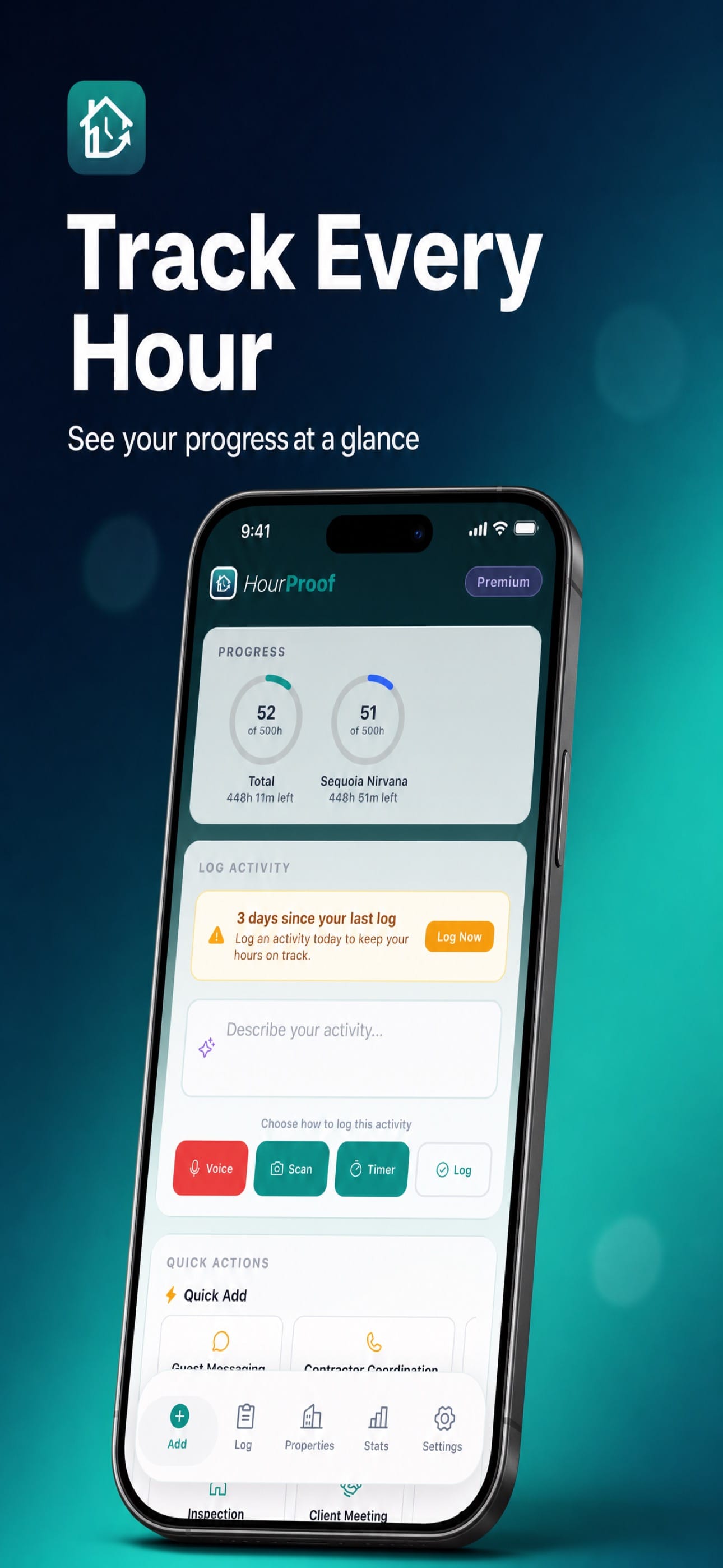
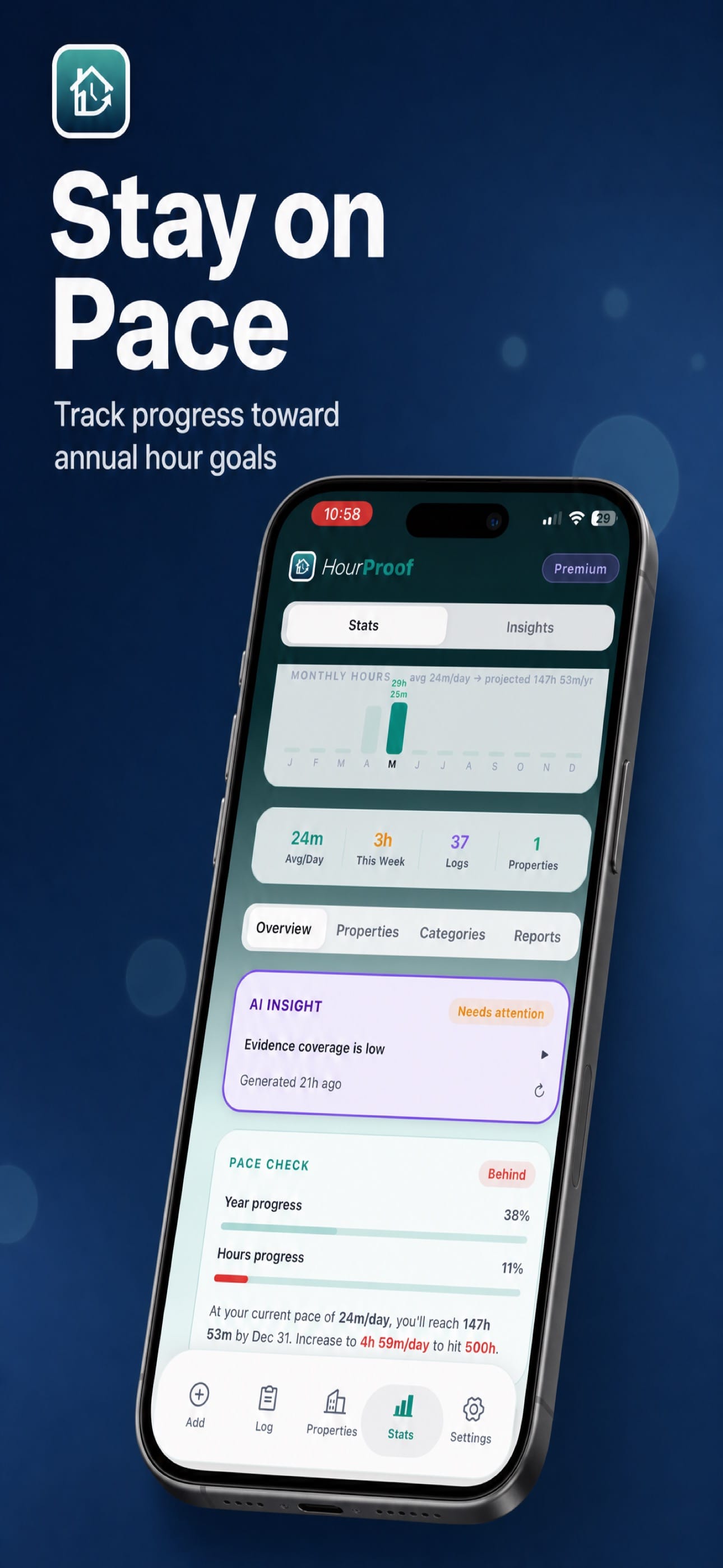
Monitor progress toward the 100-hour Short-Term Rental and 750-hour Long-Term Rental material participation thresholds with visual dashboards.
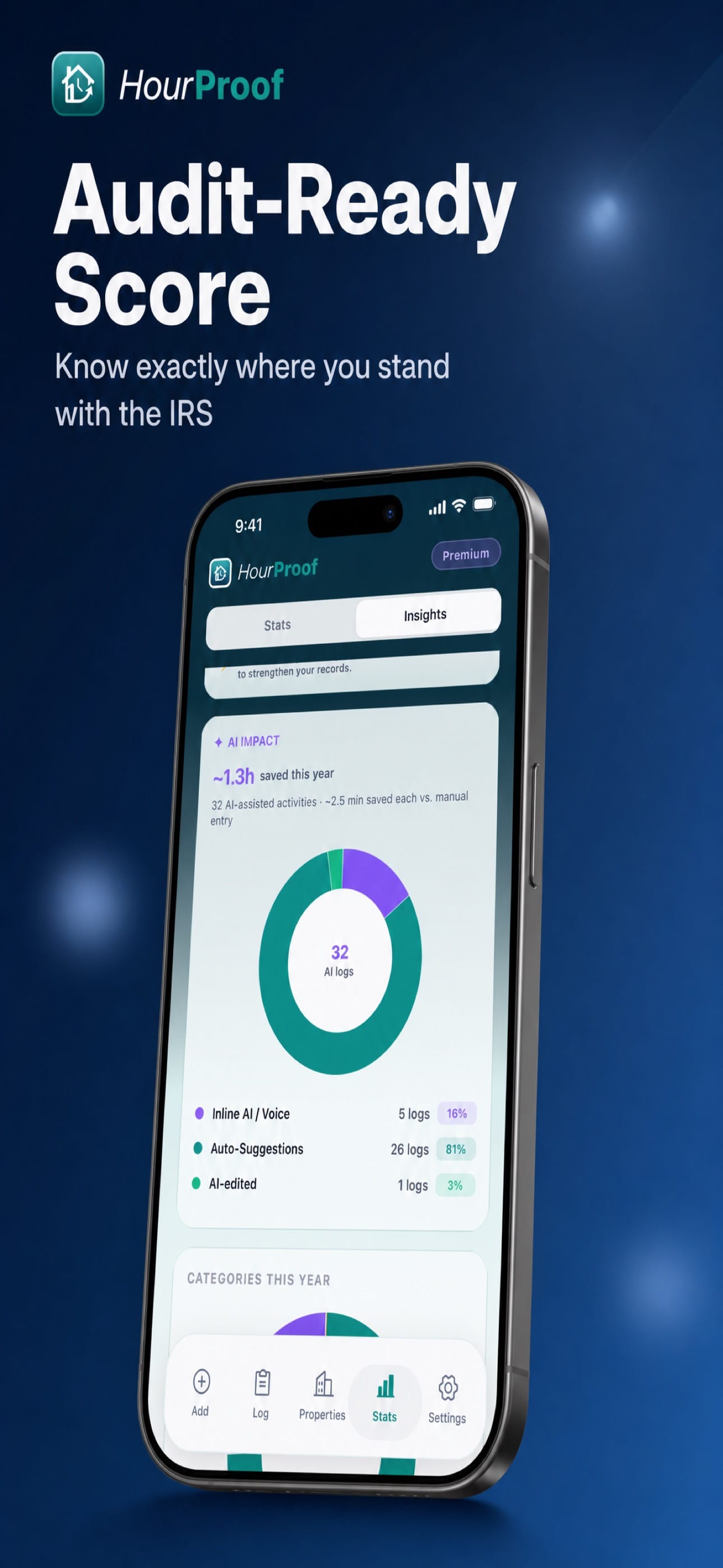
Generate detailed reports grouped by property, category, or date range. Export for your CPA or tax documentation.
A clean, intuitive interface designed for fast activity logging on the go.

Swipe to see more →
STR Strategy
Many investors search for the "STR tax loophole" when they are really trying to understand how short-term rental activity can be treated differently when material participation is present. The tax position may be nuanced, but the operational problem is simple: if you cannot show your work, you weaken your case.
Contemporaneous Records
Contemporaneous logs capture the date, property, task, duration, and supporting evidence close to the time the work happened. That is much stronger than rebuilding a year of hours from old texts, receipts, and calendar guesses a few days before tax filing.
Who It Helps
HourProof is a rental property activity tracker for investors who need cleaner documentation around short-term rental management, self-managed portfolios, and year-round participation tracking. It helps keep records organized before tax season becomes a scramble.
Growth Pages
These pages target the queries that convert better than broad informational traffic: CPA workflows, cost seg conversations, and material participation templates.
Partner Page
Show how better rental activity logs can support conversations around tax strategy, documentation discipline, and year-round client readiness.
Visit pagePartner Page
Help investor clients document material participation with organized logs, evidence attachments, and CPA-ready reports.
Visit pageResource
A search-friendly template page for investors looking for what to track, how to structure entries, and what evidence to keep.
Visit pageFAQ
Investors use the phrase "STR tax loophole" to describe a short-term rental tax strategy tied to material participation rules. It is not a shortcut by itself. The strategy depends on facts, time spent, and proper records, so investors should confirm eligibility with a CPA or tax advisor.
The 750-hour rule is one of two requirements for qualifying as a real estate professional under IRS rules. You must spend at least 750 hours per year in real property trades or businesses in which you materially participate, and real estate must be your primary time commitment (more than half your working hours).
It depends on which of the 7 IRS tests you use. The most common are Test 1 (more than 500 hours in the activity) and Test 3 (more than 100 hours, and more than anyone else). For STR investors who self-manage, 100+ hours is often the most accessible threshold.
Contemporaneous logs help show what work was done, when it was done, how long it took, and which property it supported. That makes your records more credible than reconstructing hours after the fact from memory.
A strong log includes the date, property, activity description, duration, and supporting evidence when available, such as receipts, photos, emails, or calendar entries.
Yes, if you want STR rental losses to offset active income. Short-term rentals with average stays of 7 days or less are not classified as rental activities under passive activity rules, so material participation alone can make losses non-passive — without needing real estate professional status.
HourProof is designed to help real estate investors log rental activities, track progress toward participation thresholds, and keep organized records in one place. Users should still rely on their tax professional for advice about eligibility and filing positions.
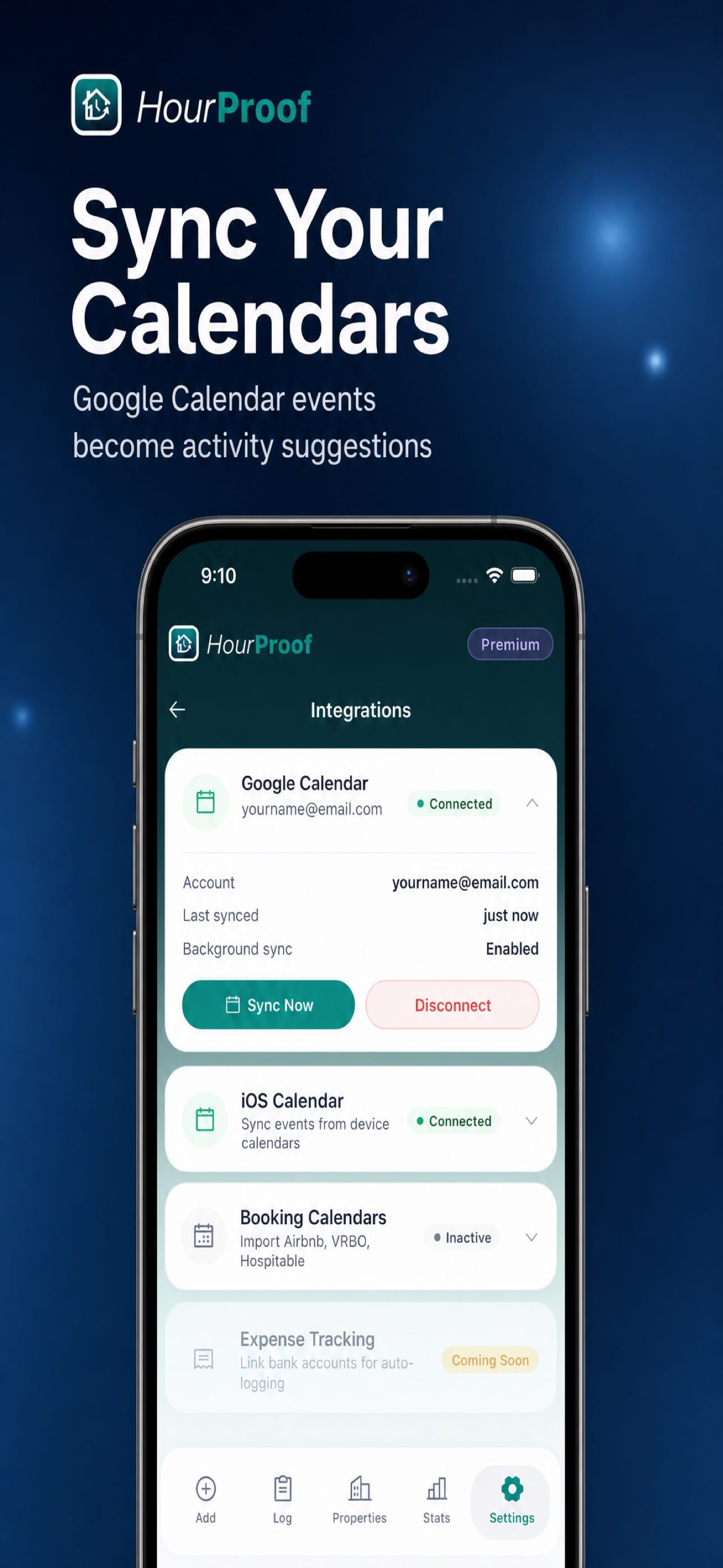
HourProof has a free plan and one paid plan: Premium at $19.99/month or $139.99/year. Free covers core hour tracking; Premium adds AI-assisted and voice logging, receipt evidence, calendar sync, the ChatGPT/Claude connector, and CPA-ready exports.
Resources
Straightforward articles on material participation, contemporaneous logs, and better documentation habits for short-term rental owners and real estate investors.
2026-10-16 · 3 min read
Spouse participation can count even with separate returns. A 120-hour example shows the rule and the records to keep.
Read article2026-10-13 · 3 min read
One longer booking does not automatically disqualify an STR. See the customer-use calculation and why participation and deduction limits still matter.
Read article2026-10-12 · 3 min read
Keep rental trip miles beside the activity they supported, with optional mileage fields and a date-based estimate in the web activity editor.
Read article2026-10-06 · 3 min read
A short guide to the two parts of material participation Test 3, the cleaner-hours comparison, and the records that support your STR tax strategy.
Read article2026-07-30 · 6 min read
HourProof is now an official ChatGPT app, and works in Claude too. Say "log two hours fixing the deck yesterday" and it lands in your contemporaneous log — structured, labeled, and safe by design.
Read article2026-06-14 · 7 min read
Now on web, iOS, and Android. Log activities four ways, attach evidence, watch your §469 standing, and export a CPA-ready package — here is everything HourProof can do.
Read article2026-06-05 · 8 min read
Three purpose-built REPS tracker apps compared side-by-side: features, pricing, platform support, and gaps. Which one is right for STR investors and real estate professionals?
Read article2026-03-24 · 6 min read
Cost segregation accelerates depreciation. Material participation makes those deductions usable against active income. Here is how the two strategies work together.
Read article2026-03-24 · 6 min read
The grouping election lets you combine hours across properties for one material participation test. Here is when it helps and when it can hurt.
Read article2026-03-24 · 7 min read
Airbnb hosts have a tax advantage: STR losses can be non-passive without REPS. But you still need to prove material participation with documentation.
Read article2026-03-24 · 7 min read
The IRS expects detailed, dated, specific records. This guide covers exactly what to log, how often, and what evidence to keep.
Read article2026-03-24 · 7 min read
Rental losses can be powerful tax benefits — but the IRS has strict rules on when and how much you can deduct. Here is how it works.
Read article2026-03-24 · 8 min read
REPS is one of the most powerful tax designations for rental investors. Here is everything you need to know about qualifying and documenting it.
Read article2026-03-24 · 7 min read
STRs and LTRs are taxed very differently. The 7-day rule changes everything about passive activity treatment, REPS requirements, and loss deductions.
Read article2026-03-24 · 9 min read
The IRS defines material participation tests. You only need to pass one — but you need to know which one fits your situation and how to document it.
Read article2026-03-24 · 8 min read
The 750-hour rule is one of the most discussed thresholds in rental real estate tax strategy. This guide covers what it requires, how it fits into REPS qualification, and why documentation matters.
Read article2026-03-23 · 9 min read
The so-called STR tax loophole depends on rental classification, material participation, and records. Here is what investors should understand before relying on it.
Read article2026-03-23 · 6 min read
If you are trying to support material participation, your log quality matters almost as much as your hours. This guide covers the records that actually hold up better.
Read articleJoin our community to get updates on new features, tips for material participation tracking, and more.